
Buying a villain Seseh
Seseh is a banjar and a desa adat of Cemagi, in the kecamatan of Mengwi, north of Munggu. The shoreline remains that of a village, between rice fields and access to the sea. Buying a villa here means measuring a narrower demand than on the coast that is already established.
Talk about your projectDiscover Seseh
Seseh is not a separate administrative desa, and it is not Munggu. The banjar dinas of Seseh and the desa adat of Seseh are part of Desa Cemagi, in the kecamatan of Mengwi, kabupaten of Badung. The Ministry of Tourism places Pantai Seseh in that same desa. Confusing the Seseh coastline with the centre of Cemagi, or with Munggu, shifts both the address and the analysis.
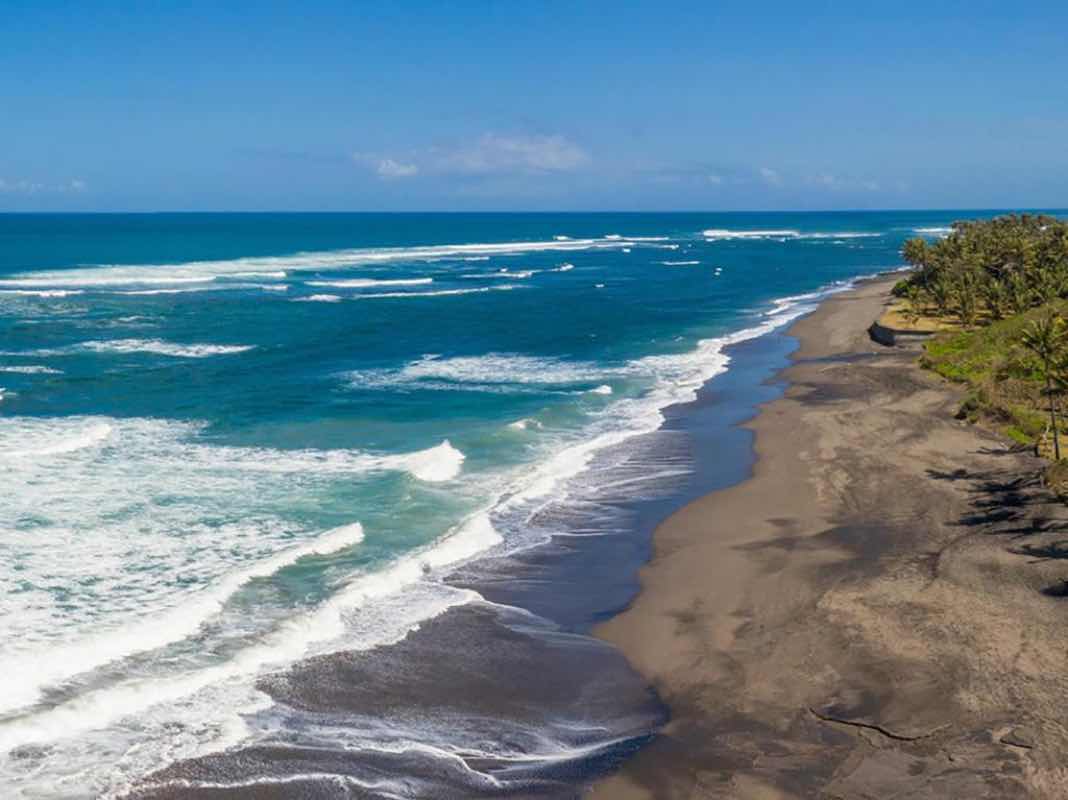
The coast is dark volcanic sand, open to the ocean, with a swell that suits surf and other wind sports according to the day. Inland, the territory of Cemagi remains partly agricultural and village-like. Upscale villas have been set into this landscape without forming a continuous built front. The pace is slower than in Canggu: fewer people passing through, fewer immediate services, and greater dependence on a car or a scooter.
That slowness is the tourism product. It appeals to intimate stays, to couples and to travellers who accept being further from the best-known cafés and beaches. It is also an operating constraint. A tenant who wanted Canggu, and then discovers the journey time, may not return.
Access is by village roads, north of Pererenan and of Munggu. The south-west remains within reach, on a different kind of access. The sensitivity of the site lies in the rice fields, the shoreline and a scale that bears rapid densification poorly.

Why visit Seseh?
Visitors who choose Seseh are looking for quiet, a villa and access to the sea, rather than a complete neighbourhood life. Couples and intimate stays fit this coastline better than groups, digital nomads or a diving clientele. Surf is available here, and it does not organise the whole of the demand.
01
Seseh Beach
Pantai Seseh is the reference point of the area. The Ministry of Tourism describes it as a dark-sand beach, exposed to a swell that can suit surfing, and lined with a few simple services. It is a village shoreline, with little of the equipment of a developed waterfront.
02
Rice fields and housing
The setting sought by the villas is as much agricultural as it is marine. That combination is fragile. Building or buying beside a rice field means looking at what the neighbouring plots can become, and at what an agricultural neighbourhood implies day to day.
03
A village scale
Temples, banjars and local life are the structure of the place, and they determine access, ceremonies and the way a project is received. A serious purchase takes account of this context before reasoning in overnight stays alone.
04
The south-west, at a distance
The denser cafés, restaurants and services are mainly in Pererenan and in Canggu. That distance protects the quiet. It also lengthens every practical task, from laundry management to a tenant’s evening. It has to be counted in the project, and kept in view.
Why invest in Seseh?
Seseh is a more selective market, and a less deep one, than Canggu or Pererenan. Supply consists of scattered upscale villas, outside an established hotel stock. The plausible rental demand is for quiet stays, often for couples, from guests willing to accept fewer immediate services. Nothing indicates a depth comparable to that of the already internationalised neighbourhoods of the south-west.
Where an advantage is real for a given property, it is the setting: coastline, rice fields and little commercial continuity. It holds only for as long as the villa is well built, accessible and clearly located in Seseh, rather than sold under a better-known neighbouring name. Choosing this village only for its proximity to Canggu, without measuring demand, compares markets that do not host the same stays.
The constraints are access, the environmental sensitivity of a small agricultural and coastal territory, and a market that is still narrow. A scarce property can take a long time to let and a long time to sell. Market maturity is uneven: some villas are finished, and the service ecosystem is less so. Indonesian property law does not become simpler because the village is quieter. It is checked with the same care. Access by the roads of Cemagi, the distance from Canggu’s services and the agricultural surroundings change a tenant’s daily life. These points are verified on site.
What next for Seseh?
Seseh is not static. Villas are being built, and the Cemagi coast is identified as a place to visit. Inferring from that a shift towards a neighbourhood comparable to Canggu would go too far. No major facility, public announcement or works timetable is established on this page.
The clearest scenario is gradual development, limited by the roads, by agricultural land and by the size of demand. That pace can preserve the character that attracts people today. It can also break, locally, if several projects come to market at the same time without additional tenants.
Over time, a property is of interest if it remains desirable to a clientele that is still looking for quiet, and if the right can be transferred on sound terms. Proximity on a map to more established markets does not, by itself, establish that interest. Rice fields and a lightly equipped shoreline are the present condition. That condition can change without a spectacular announcement, plot by plot. The useful question concerns the adjoining land, ahead of any account of a future international neighbourhood. Seseh can remain a coastline of scattered villas. That is the scenario most consistent with the demand that can be observed.
Your property project in Seseh
A project in Seseh is prepared by accepting the scale of the place. BEL-AIR first clarifies your objectives, then selects properties whose location is genuinely that of Seseh, and not that of a neighbouring village. We study the construction, the access and the contract, and we support you through the acquisition steps, with the legal and tax reservations that an individual file requires. No decision should precede a visit to the access roads.
Speak with an adviser