Who can hold it
- Hak sewa
- As provided in the contract.
- Hak milik
- Indonesian citizens.

Legal and tax
By Mathieu MAILLOT — 8 min read
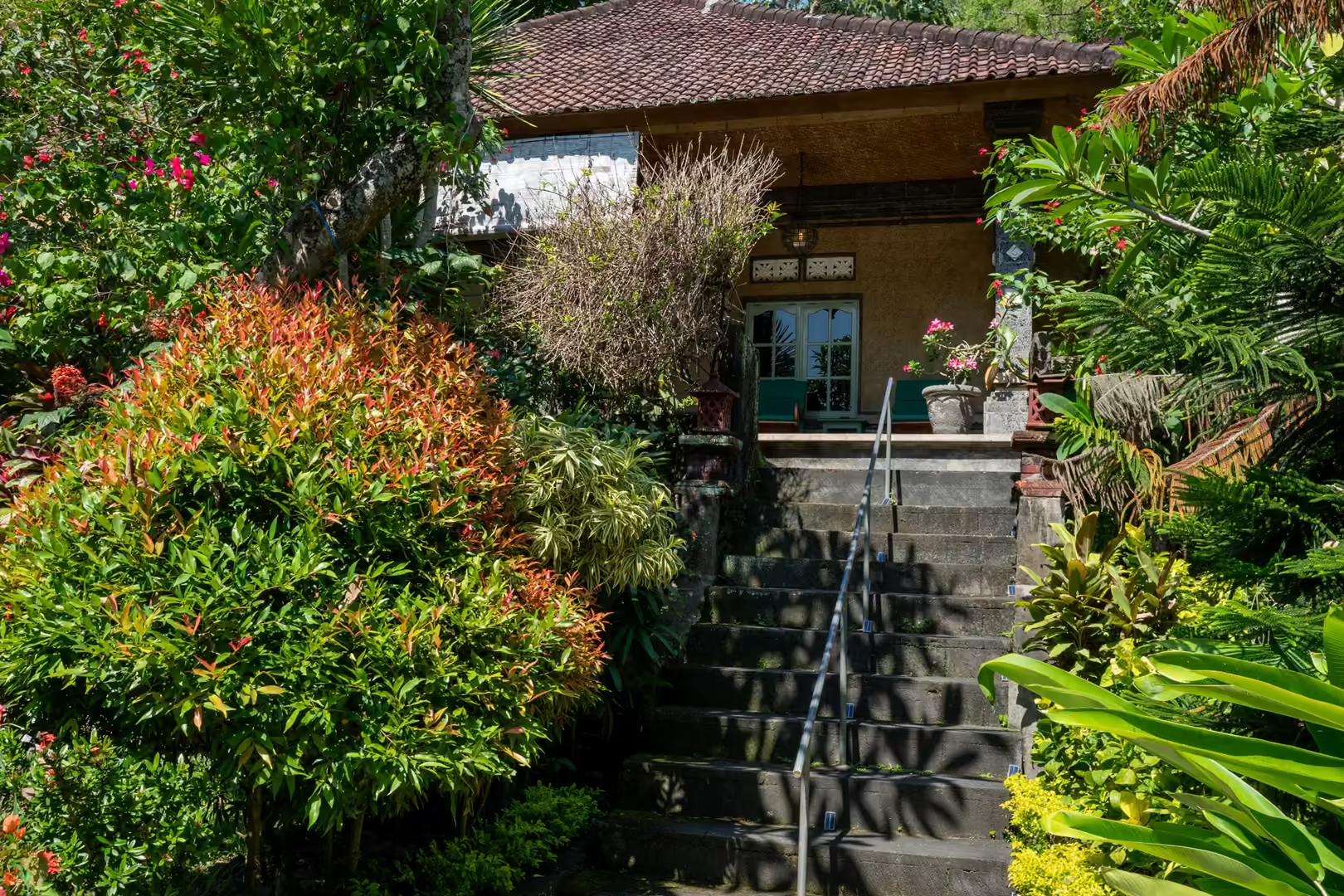
Hak sewa, often called a leasehold, is a right of use for the term written in the contract. It does not transfer ownership and does not, on its own, carry a return. What rights does it actually grant? How is its expiry read? Resale and renewal are not automatic. This article sets out the points to watch before you sign.
What is a leasehold (hak sewa) in Bali?
A leasehold, or hak sewa, is the leasing of a right of use over a property in Bali for a term set in the contract. It typically concerns villas, apartments or built land. Unlike freehold (hak milik), which is reserved for Indonesian citizens, a leasehold never grants full ownership or automatic transfer of the property. The rights are therefore limited in time and concern only use, without guaranteeing a transfer in perpetuity.
The term is the one written in the contract. An option to extend exists only if the contract provides for it. It is not a statutory standard of 20 to 30 years. Negotiation and signature require a careful reading of the right actually granted.
For an investment in Bali, hak sewa has advantages and limits compared with hak milik, which is reserved for Indonesians. Government Regulation No. 18 of 2021 concerns the ceilings for HGB and hak pakai, not the term of a hak sewa. Text of the regulation: PDF of regulation No. 18 of 2021. Operation of the property is checked separately, according to the activity.
The term of a hak sewa is the one written in the contract. There is no standard term. Renewal is not secured: it exists only if the contract provides for it. The official deed sets out all the obligations: the amount of the initial payment, the conditions of the lease, the rights of operation, and so on. This document must be authenticated by a local notary (PPAT) and registered with the competent authorities. Instructing a specialist lawyer helps limit the risks linked to the interpretation of the clauses, particularly for a foreigner who wants to buy a villa in Bali.
The whole payment for the leasehold right is due as soon as the contract is signed. This operation requires administrative rigour and professional advice in order to avoid any later challenge at the time of registration or transfer of the lease.
As a general rule, payment is made in one or more instalments, before official registration. The leasehold holder can then assign or sell the lease for the remaining period, subject to complying with any contractual restrictions. This option makes it possible to recover part of the investment before the leasehold expires.
On a resale, it is essential to inform the buyer of the expiry date and of the possible renewal conditions. Full transparency helps maintain the value of the property and ensures a transaction that complies, through an authorised notary, thus securing the sale of property in Bali.
If the leasehold beneficiary dies before the end of the term, the lease can be transferred to the designated heirs, provided that this possibility is written into the notarial deed. Otherwise, the succession risks meeting administrative obstacles, especially for a non-resident. These points must be clarified as soon as the contract is drafted.
Operation of the property varies according to the zoning: private use, short-term letting or a commercial activity. Each configuration requires specific authorisations. Some contracts expressly restrict certain uses; every legal aspect should therefore be checked, including property tax in Bali, which applies differently according to the use.
Expiry of the leasehold is a crucial stage for any investor. On the expiry date, the right of use ends automatically unless an extension was negotiated beforehand. Full ownership then returns to the Balinese freehold holder, without any mandatory compensation for the outgoing lessee.
As for villas that have been built, their fate depends on the provisions of the contract: unless expressly stated, all buildings become the property of the freehold owner at the end of the lease. Some recent agreements include compensation or buy-back clauses, but nothing legally requires a free renewal or systematic compensation after the leasehold expires.
Anticipating the renewal of a leasehold on good terms requires careful preparation from the first drafting of the contract. Several parameters influence whether a long-term lease can be extended, and on what terms.
A renewal option exists only if the contract writes it in. It is not automatic and has no usual term. Its price, when it is provided for, is read in the clauses.
Without an extension clause, no renewal is guaranteed: only a fresh negotiation with the freehold owner can lead to an extension of the hak sewa. If there is no agreement, the property returns in full to the landowner.
Before signature, several points absolutely must be checked:
These checks considerably limit the risk of a dispute on resale or transfer. Professional support remains essential given how quickly the regulation of property rights in Bali evolves.
Who can hold it
Right
Term
Renewal
Transfer
Operation
| Criterion | Hak sewa | Hak milik |
|---|---|---|
| Who can hold it | As provided in the contract. | Indonesian citizens. |
| Right | Use of the property. Not full ownership. | Full ownership. |
| Term | The term written in the contract. This is not a statutory standard of 20, 25 or 30 years. | No limit on duration. |
| Renewal | Only if it is provided for in the contract. It is not secured. | Not applicable. |
| Transfer | The remaining right, if the contract allows it. | Between eligible persons. |
| Operation | It is checked separately, according to the activity. The lease is not a licence. | According to the applicable law. |
When a leasehold is acquired, payment for the long-term lease is made on signature or according to the terms set in the contract. No classic mortgage loan is offered by local banks: the transaction is made mainly with the buyer’s own funds. To secure the operation, it is essential to use a notary and to register the contract officially.
On property tax in Bali, you should allow for taxes and duties relating to the purchase of the hak sewa, as well as tax on the income generated by rental management of the property.
Where the contract provides for it, the assignment of a hak sewa covers the remaining term. That term can enter the negotiation, together with the location, the condition of the property, the clauses and the market. It does not set the price. The tax treatment of the operation is checked separately.
Any sale of property in Bali in the form of a leasehold must receive the freehold owner’s explicit agreement and be formalised before a notary in order to guarantee the validity of the transfer.
Besides a leasehold, other arrangements such as hak guna bangunan exist through local companies, but they involve regulatory constraints and additional costs. Hak sewa remains the preferred solution for any purchase of a villa in Bali by a non-Indonesian investor who wants to simplify the administration.
Some developers now offer leaseholds that already include one or more renewal options, which should be examined carefully before any decision to invest in property in Bali.
Despite Bali’s strong appeal and the growing inflow of international investors, undertaking a property project under a leasehold requires anticipation, command of the legal clauses and recourse to recognised experts. Favouring official channels and specialist advice is essential, whatever type of lease is chosen.
The market’s constant evolution leads investors to diversify leases and asset strategies. At every stage, however, checking the title, the prospects of renewal and the succession conditions remain the key factors in making an investment last and enjoying the momentum of the Balinese property sector with peace of mind.

We advise international investors looking in Bali and Lombok: location, budget, how to hold the asset, and which projects to consider.